Staying Consistent With Medication When Motivation Fades

January often brings a surge of genuine motivation to take better care of your health. You may start the year wanting to be more consistent with medication, routines, and self-care, especially when managing a chronic condition.
However, good intentions alone rarely carry people through the whole year.
What the research shows
Research consistently shows that medication adherence depends more on routines, environmental cues, and system design than on motivation or willpower. Studies have found that routine disruptions increase missed doses, preventive medications are more likely to be skipped, reminder-only approaches often lose effectiveness over time, and physical or structured systems can improve adherence by reducing cognitive load and reliance on memory. Research also suggests that adherence can decline during predictable routine disruptions, such as holidays or school breaks, when daily structure changes and habit cues are disrupted.1-6
Why Do Medication Routines Break?
Understanding why adherence falters helps explain what actually supports consistency. It usually isn't a lack of discipline; it is simply that the consistent signals your brain relies on have been interrupted.
Routine Changes Disrupt "Autopilot"
Medication routines work best when they run on autopilot. You may take your medication automatically because it’s linked to something you already do every day, like brushing your teeth or pouring your morning coffee. Learning to conquer your mornings is often the first step to stability.
When that routine changes, the habit loses its trigger. Sleep schedules may shift, meals move around, and travel or time off interrupts familiar cues.
Research shows medication adherence depends heavily on these daily cues rather than memory alone.1,3 Without a trigger, remembering takes effort; and effort is much harder to sustain during busy or stressful days.
The Challenge of Prevention
Motivation is easier to sustain when you feel an immediate payoff — like pain relief or symptom improvement. Many preventive medications don’t work that way. They’re taken to lower future risk, not to change how you feel today.
When you feel fine, taking medication can start to feel optional. Without a symptom to fix or pain to relieve, consistency becomes harder to maintain. Research shows that preventive medications are more likely to be missed, precisely because their benefits are not immediately felt.2
When Motivation Fades, Support Matters Most
Missing a dose is usually a system problem, not a personal failure. Human memory has limits, and when routines change or motivation dips, relying on memory alone becomes fragile. Long-term adherence improves when responsibility shifts from daily motivation to supportive systems.
Why motivation alone isn’t enough?
Motivation plays an important role in starting healthy behaviors, but it is rarely stable over time. Energy, mood, stress, and symptoms naturally fluctuate.
If you live with a chronic condition, or help care for someone who does, you know how challenging consistency can be. You know that care doesn’t pause on difficult days, and it doesn’t get easier just because today happens to be a good one. Expecting yourself to feel highly motivated every day places an unrealistic burden on your health routine.
When medication schedules depend on how you feel on a given morning, consistency often breaks during fatigue or stress. This helps explain why so many New Year’s resolutions start with hope but fade once life gets busy or exhausting.
How can systems help when motivation is low?
Supportive systems act as a safety net. They provide cues, structure, and gentle nudges during periods when motivation is low — protecting routines without requiring extra mental effort.
This shifts the focus away from “trying harder” and toward building support that makes consistency easier, even on difficult days.
What Helps You Stay Consistent With Medication?
Long-term medication adherence improves when your environment is designed to support you on your busiest or low-motivation days. Consistency is easier when the burden of remembering is shifted from your mind to a reliable structure that works even when energy or focus is limited.
Anchoring medication to existing habits
Habit stacking is the practice of linking a new behavior to something you already do automatically. By pairing medication with an established habit, like brushing your teeth or making your morning coffee - taking your dose becomes part of a sequence rather than a separate decision.
On days when energy is low or routines feel heavy, the existing habit carries you forward. You’re not asking yourself whether to take your medication; you’re simply completing a routine that’s already in motion.
Reducing daily decision fatigue
Every decision draws on mental energy. When medication routines involve repeated questions “Did I take this already?” or “Should I wait until later?” — consistency becomes harder to maintain, especially during busy or stressful days. This uncertainty is especially common when you are trying to manage as-needed medications alongside your daily prescriptions.
Systems that answer these questions for you. Organizing doses in advance, keeping medication visible, or using tools that clearly show whether a dose has been taken removes uncertainty. By reducing decision-making, you protect your mental energy for the rest of the day.
Using physical and environmental cues
Physical cues change the environment, not just intentions. Seeing a pill organizer, an open compartment, or a dispensed dose provides immediate confirmation that a reminder alone cannot.
Research indicates that physical cues reduce ambiguity and lower reliance on internal memory, making adherence more consistent over time.5 These cues act as gentle nudges when attention or motivation is low.
Where automatic pill dispensers fit in
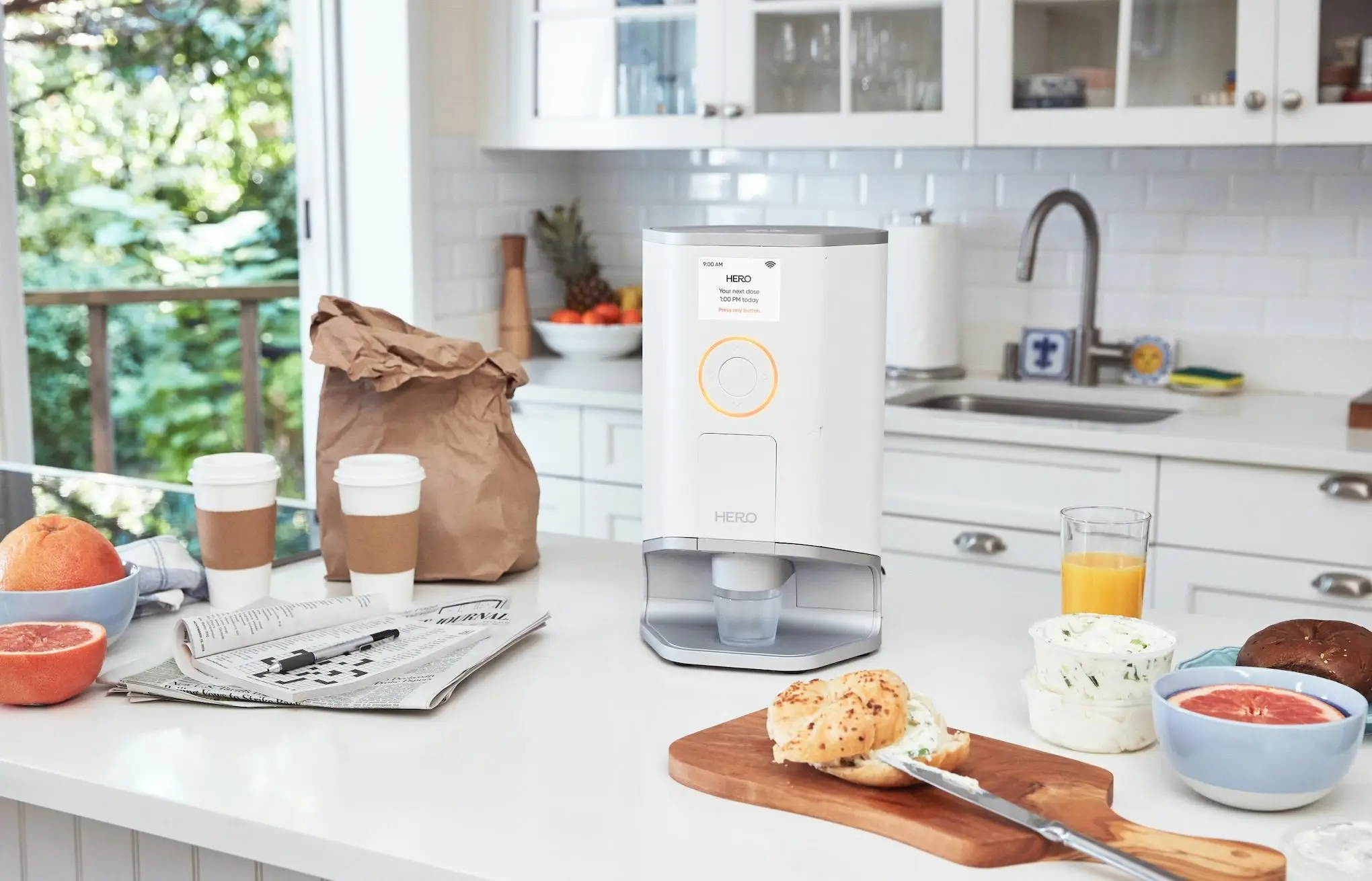
An automatic pill dispenser is a category of assistive technology designed to help people manage medications. Unlike manual pill boxes that simply store pills, these devices actively manage them - sorting, scheduling, and prompting you to release the correct doses at scheduled times, so you don't have to.
Automatic pill dispensers often provide visual or audible cues, and can also create a digital log of every interaction. This allows you to track exactly what medication was taken or missed and share that history with your doctor to help optimize your care plan.
While not necessary for everyone, they can be especially helpful in certain situations:
- Managing multiple medications: Supporting complex regimens with different doses or schedules.
- Routine disruptions: Providing a stable cue during travel, shift work, or schedule changes.
- Caregiver support: Offering peace of mind and supporting independent living for loved ones.
Medication dispensing systems support consistency by providing a stable structure for medication-taking, even when daily routines change.
What to Do If You Miss a Dose
When prescriptions pile up, it can be easy to miss a dose. Even with the good systems, missed doses happen. They usually signal a gap in your routine, not a personal failure. If you realize you have missed a medication, it is helpful to pause and check rather than guess.
General guidance regarding missed doses
While directions vary by medication, taking a cautious approach usually includes the following:
- Check the Instructions: Most Patient Information Leaflets (included with prescriptions) provide specific directions for what to do if a dose is missed.7
- The Risk of "Doubling Up": It is a natural instinct to want to "catch up" by taking two doses at once. However, most medication labels explicitly warn against this, as it can unintentionally increase the risk of side effects.7
- When in Doubt, Ask: If the instructions aren't clear, a quick call to your pharmacist or your health care provider is the safest path. They can tell you whether to take the dose late or simply wait for the next scheduled time.8
- Getting Back on Track: Once the immediate question is resolved, the goal is simply to return to your usual schedule. Consistency is about the long term, not a single moment.
How to Stay on Track When Routines Change
Routine changes don’t only happen during holidays. Weekends, travel, illness, and busy periods can disrupt medication schedules at any time of year. The goal isn’t to avoid these changes, but to plan for them in ways that protect consistency.
Planning for weekends, travel, and busy days
Routine disruptions are often predictable. Weekends look different from weekdays. Travel changes timing and environment. Busy periods leave less mental space for remembering small tasks.
Planning ahead can reduce missed doses during these shifts. Portable organizers, adjusted timing plans, or preparing doses in advance can help medication routines adapt when daily structure changes. When planning happens before routines break, consistency becomes easier to maintain during the disruption itself.
Building a backup system instead of relying on memory
Strong medication routines rarely rely on a single cue. They work best when support is layered.
A habit anchor may be paired with a physical organizer or a visible cue. When one layer fails — a missed reminder or a disrupted routine — another can step in. This redundancy reduces reliance on memory and motivation alone.
Backup systems don’t signal failure. They acknowledge that real life is unpredictable and that consistency improves when routines are supported from more than one direction.
Simple medication adherence strategies that actually stick
Sustainable medication routines are simple, visible, and forgiving. Systems that are easy to understand and easy to restart are more likely to hold up over time.
Keeping systems simple reduces friction. Reviewing and adjusting the system, rather than relying on renewed motivation, makes consistency easier to maintain.
Good systems don’t expect people to feel motivated every day. They are designed to support consistency even when energy, focus, or confidence is low.
Quick takeaways
- Medication adherence depends more on supportive systems than on motivation or willpower.
- Motivation naturally fades, especially during routine changes, stress, or fatigue.
- Missed doses are usually a sign of system gaps, not a lack of care or discipline.
- Consistency improves when medication routines rely on cues, structure, and reduced decision-making.
- Physical and environmental cues often support adherence better than reminders alone.
- Tools like automatic pill dispensers can provide stability when routines and motivation fluctuate.
A more supportive way forward
Staying consistent with medication is not about trying harder or feeling motivated every day. It’s about building support that holds steady even when energy, attention, or routines change.
When medication routines rely less on memory and more on structure, consistency becomes more realistic and more forgiving. Missed doses don’t signal failure — they offer information about where additional support may be helpful.
By focusing on systems that continue to work on difficult days, medication adherence becomes a sustainable part of daily life, rather than a goal that depends on motivation being high.
Complex med schedule?
We solved it.
Hero’s smart dispenser reminds you to take your meds and dispenses the right dose, at the right time.

References
- Gardner B, Lally P, Wardle J. Making health habitual: The psychology of habit formation. British Journal of General Practice. 2012;62(605):664-666.
https://bjgp.org/content/62/605/664 - Osterberg L, Blaschke T. Adherence to medication. New England Journal of Medicine. 2005;353(5):487-497.
https://www.nejm.org/doi/full/10.1056/NEJMra050100 - Vrijens B, De Geest S, Hughes DA, et al. A new taxonomy for describing and defining adherence to medications. British Journal of Clinical Pharmacology. 2012;73(5):691-705.
https://bpspubs.onlinelibrary.wiley.com/doi/10.1111/j.1365-2125.2012.04167.x - Thakkar J, Kurup R, Laba TL, et al. Mobile telephone text messaging for medication adherence in chronic disease: A meta-analysis. JAMA Internal Medicine. 2016;176(3):340-349.
https://jamanetwork.com/journals/jamainternalmedicine/fullarticle/2484905 - Conn VS, Hafdahl AR, Cooper PS, et al. Interventions to improve medication adherence among older adults: Meta-analysis of randomized controlled trials. The Gerontologist. 2009;49(4):447–462.
https://pubmed.ncbi.nlm.nih.gov/19460887/ - Driscoll KA, Johnson SB, Tang Y, et al. Does routine matter? A longitudinal examination of medication adherence in adolescents with type 1 diabetes. Journal of Pediatric Psychology. 2019;44(3):289–297.
https://pubmed.ncbi.nlm.nih.gov/31079072/ - NHS Specialist Pharmacy Service. Advising on missed or delayed doses of medicines. NHS SPS. 2020. https://www.sps.nhs.uk/articles/advising-on-missed-or-delayed-doses-of-medicines/
- National Institute on Aging. Taking medicines safely as you age. National Institutes of Health. 2024.https://www.nia.nih.gov/health/medicines-and-medication-management/taking-medicines-safely-you-age
Common Questions About Staying Consistent With Medication
That is normal. Systems aren't meant to eliminate mistakes entirely; they are meant to make consistency easier over time. Missed doses usually signal that a routine needs adjustment, not that the system failed. If you find yourself missing doses frequently, it might be time to review common medication mistakes to see if a small tweak can get you back on track.
If medication-taking feels mentally exhausting, stressful, or easy to forget during busy days, that is often a sign that more structure could help. Support isn't about severity—it is about reducing daily effort. You might benefit from exploring tools designed to bridge the gap between intention and action.
You should always consult your healthcare provider before making changes. As schedules, health needs, or responsibilities change, your systems often need to change too. For example, returning from travel or a long break may require getting your routine back on track using different cues than before.
Using tools doesn't replace responsibility—it redistributes it. Tools are designed to support consistency when attention or motivation is limited, not to take control away. Whether it's a simple organizer or technology designed to support independence, the goal is to free up your mental energy for living, not just managing meds.
The contents of the above article are for informational and educational purposes only. The article is not intended to be a substitute for professional medical advice, diagnosis, or treatment. Always seek the advice of your physician or other qualified clinician with any questions you may have regarding a medical condition or its treatment and do not disregard professional medical advice or delay seeking it because of information published by us. Hero is indicated for medication dispensing for general use and not for patients with any specific disease or condition. Any reference to specific conditions are for informational purposes only and are not indications for use of the device.