Coming Home From the Hospital: A Guide to Medication Management After Hospital Discharge

After a hospital stay, the medication list looks different. Sometimes very different. Errors at this handoff are common, and the first two weeks home are when they're most likely to cause problems. This guide covers medication management after hospital discharge: what to check, what to ask, and how to build a routine that holds.
Why do medications often change at discharge?
Anyone who has ever brought a loved one home from the hospital knows how hard that moment can be. The relief is real - and so is the overwhelm. The paperwork is thick. The medication list looks different from before. And you're trying to hold it all together while also just being glad they're home. That combination is a lot to carry.
A hospital stay rarely ends with the same medication list it began with. During treatment, clinicians may start new medications to manage acute symptoms, pause existing ones temporarily, or adjust doses based on how the body responds. When your loved one is discharged, they may go home with a changed medication list; some medications familiar, some new, and some old ones with doses that have been adjusted.
For older adults already managing multiple medications, a situation known as polypharmacy, this gets complicated quickly. According to a study published in Global Health Research and Policy, nearly half of adults 65 and older were taking five or more medications at once.1 The CDC reports that roughly one in three U.S. adults aged 60 - 79 filled five or more prescriptions in any given month.2
Add a hospitalization to that picture, and there's a real chance something on that medication list doesn't quite line up.
What is a medication discrepancy?
When your loved one leaves the hospital, their medications may look different than before, and that's expected. But there is a difference between an intentional change a doctor made and a medication discrepancy — an unexplained, accidental mismatch between what your loved one was taking before the hospital and what they're sent home with. These can include a medication that was accidentally omitted, duplicated, or prescribed at a different dose during discharge.4
This is more common than most people realize: a study found that among 212 patients sent home from the hospital, 89% had at least one of these mismatches, and in roughly 40% of cases, medication discrepancy was likely to cause harm.3
What is medication reconciliation (MedRec) and why does it matter?
You may hear this phrase at the hospital and not be quite sure what it means. According to the U.S. Agency for Healthcare Research and Quality, medication reconciliation is the process of reviewing a patient's complete medication list at every handoff, admission, transfer, and discharge, to catch and fix errors before they cause harm.4 It's one of the most common places where things go wrong after a hospital stay.
The Joint Commission made this a national patient safety goal back in 2005. Hospitals are required to keep an accurate medication list and pass it along at every transition.5 That requirement exists because handoffs are risky: when care moves from one setting to another, that's often when things fall through the cracks.
Even when a hospital does everything right, this process has limits. Papers get handed over, but understanding doesn't always come with them. A study published in BMJ Open Quality found that about 80% of discharged patients had gaps in understanding what their medications were for, how much to take, or how long to take them.6 It helps to go into that conversation ready to ask questions, not just receive paperwork.
What should you review before leaving the hospital?
The easiest time to catch a problem is while you're still at the hospital.
It can help to ask for a printed medication list that shows every medication: name, dose, how often it's taken, and what it's for. Comparing it, line by line, against what your loved one was taking before the hospitalization is one of the most useful things a caregiver can do at that stage.
Anything that's been added, removed, or changed is worth asking about:
- For every new medication, some helpful questions to ask are: why was it added, how long should they take it, and are there any reactions to watch for?
- For anything that's been stopped or paused: was that intentional, and does the regular doctor know?
- For any dose changes: what's the reason, and is it permanent?
A nurse, pharmacist, or discharge planner can go through the list with you - you don't have to figure this out alone. Many caregivers find it reassuring to leave the hospital able to say, without looking at the papers, what each medication is for and when it's taken. If anything feels unclear, it's always worth asking again. If you want a list to bring with you, 15 Empowering Questions to Ask About New Medications is a good starting point.

What should you do in the first week at home?
Studies show that the first two weeks are when risk is highest. A study published in the Journal of the American Geriatrics Society followed 1,000 older adults after discharge and found that nearly 1 in 5 experienced a harmful medication reaction within 45 days of leaving the hospital — and over half of those happened in the first 14 days.7 That's the window that matters most.
Building a written master medication list on the first day home can make a real difference. Including every medication, the exact dose, when it's taken, and what it's for gives everyone involved a single reference to work from - caregivers, doctors, and pharmacists alike. It can help to keep a copy at home and a photo on your phone so it's always within reach.
A consistent schedule helps too. Medications listed as "twice a day" mean something different to everyone, and anchoring each dose to a fixed point in the day may reduce the room for confusion. For many people, tying doses to routines already in place makes it easier to stay consistent without a lot of extra effort.
It's also worth keeping an eye on whether the new routine is actually working.
Research published in Health Services Research, following more than 2,600 hospitalized patients, found that nearly half didn't fully follow through on at least one discharge medication change, and those who weren't adherent to any of their medication changes had a 35% higher risk of readmission or an emergency department visit within 30 days.8
When doses are missed, it's often not carelessness or indifference, it can be confusion about which version of medications and schedule is the current one.
If a follow-up with the primary care doctor wasn't already scheduled, many people find it helpful to get one on the calendar within five to seven days. Bringing the full medication list and the discharge paperwork to that appointment gives the doctor a clear picture of what changed during the stay.
How can your pharmacist help after a hospital stay?
Your pharmacist may be one of the most underused people on the care team at this stage. They can have access to the full prescription history, they could spot interactions the hospital may not have flagged, and - unlike most doctor's offices - they're often available the same day without an appointment.
This is something worth knowing. A study published in Frontiers in Pharmacology compared patients who received pharmacist-led medication reconciliation at discharge with those who didn't. Among patients who received it, only 9.3% had clinically important medication errors at discharge, compared to 61.9% in the group that didn't. Medication reconciliation reduced the likelihood of a clinically important medication error by 20-fold.9 Not every hospital offers this routinely, but it can still happen after you're home.
Calling your regular pharmacy to ask about a medication review (sometimes called a "brown bag" review, where you bring every medication in and go through them together) is an option many people don't know they have. Research using AHRQ's brown bag tool found the process helpful for identifying causes of nonadherence and assisting prescribers.13 It's worth asking your pharmacy what they offer and whether your insurance covers a more formal session.
Thing to note: pharmacist review is one strong layer of protection, but it works best alongside follow-up care and an engaged caregiver at home. It's not a substitute for either.
What are the warning signs of a medication problem?
Medication reactions after discharge don't always announce themselves clearly. Many are easy to write off as tiredness from the hospital stay, or just part of getting older. According to the study published in the Journal of the American Geriatrics Society, nearly 1 in 5 older adults experienced a harmful medication reaction in the 45 days after discharge, and most of those happened in the first two weeks.7
According to the FDA, side effects can range from mild issues like drowsiness or an upset stomach to more serious symptoms like allergic reactions.11 The National Institute on Aging notes that common reactions to watch for include digestive changes, dizziness, skin reactions, and shifts in mood or energy.12 Not all of these are serious, some settle down as the body adjusts. But for many people, if any of them appear shortly after a medication was added or changed, it's worth mentioning to a doctor or pharmacist.
Keeping a simple log during the first two weeks can help - just the date, anything you noticed, and what was taken and when. If something does come up, that record gives a doctor or pharmacist something concrete to work from. Some of the primary care offices have a nurse line for exactly this kind of question.
The caregiver's role in making the routine stick
The first two weeks are about preventing things from falling apart. After that, the focus shifts to making the routine hold, not just for this discharge, but for the ongoing work of managing chronic conditions at home.
Research published in Medical Care found that programs designed to help people move from hospital to home worked significantly better when a caregiver was actively involved and reduced 30-day rehospitalizations by 18%. Without that involvement, the same programs showed no measurable effect.10 Your presence in that routine isn't optional. It's what makes the difference.
One habit worth building into the longer routine: reviewing the full medication list with the primary care doctor at every visit and after any specialist appointment. Medications added during a hospital stay don't always get revisited once the acute phase is over. Without someone checking the full list, it's easy for an outdated prescription to stay in rotation longer than it should.
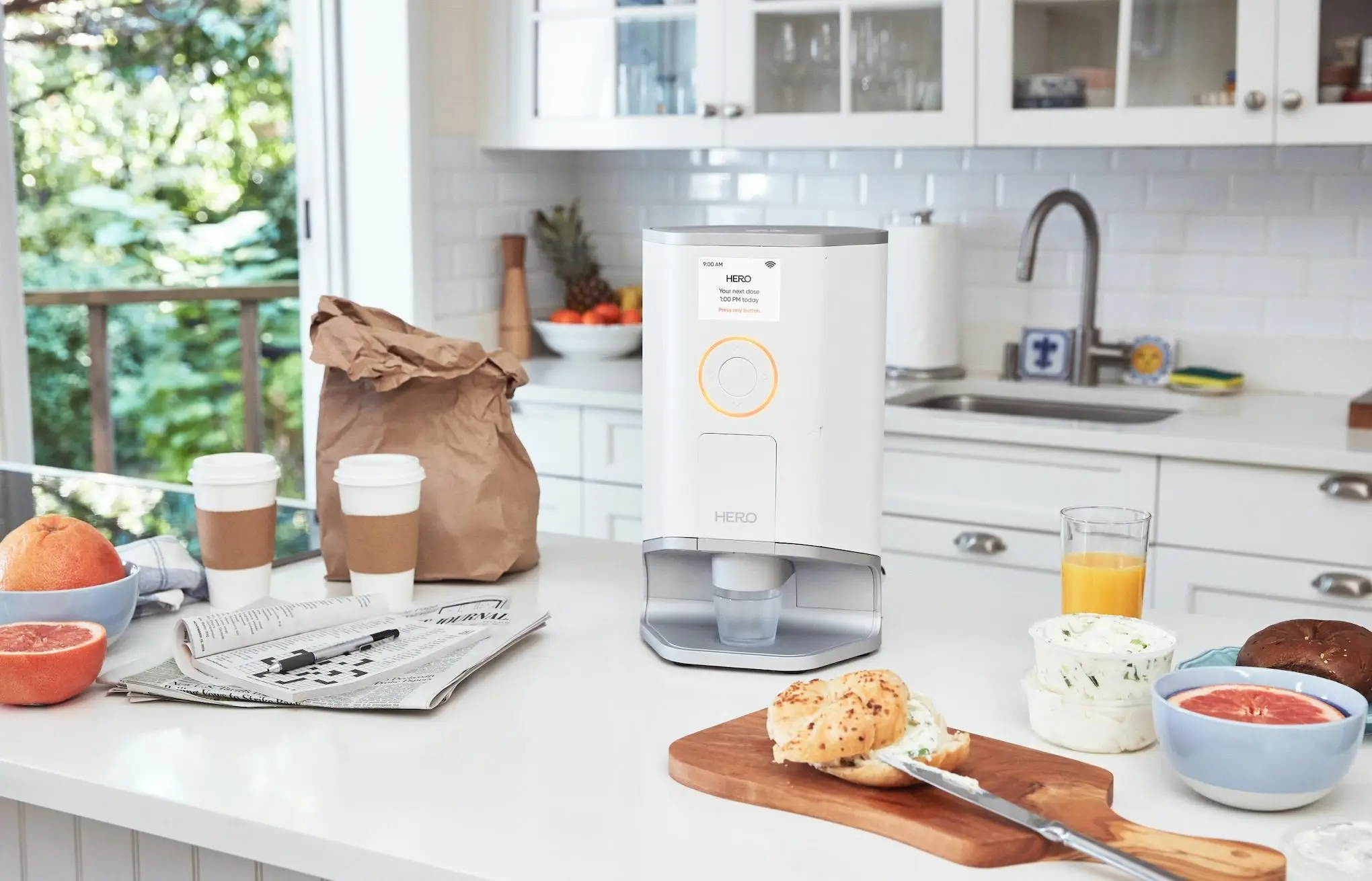
Managing a new medication schedule after discharge is detailed, careful work. That's easier when the daily logistics don't fall entirely on you. If you're weighing automation options, Hero is worth knowing about - Hero’s automatic pill dispenser sorts and dispenses on schedule, and the Hero app tracks when doses are dispensed and sends missed-dose notifications, so you're not waiting until the next visit to find out something slipped through. A no-commitment monthly plan option and a 30-day money-back guarantee make it a reasonable thing to try during a stretch like this.
Key Takeaways
- Verify the list line by line: Nearly 9 in 10 patients leave the hospital with at least one medication mismatch 3, and roughly 40% of those can cause harm. Compare what your loved one was taking before the hospital with everything on the discharge list, before you leave the hospital.
- The first 14 days are the highest-risk window: Start a written medication list on day one, every medication, dose, timing, and what it's for. Anchor each dose to a fixed point in the day to reduce the room for confusion.
- Ask why for every change: Get clear on what's new, what was stopped, and what was adjusted — and what each medication is for — before leaving the hospital.
- Lean on your pharmacist: Pharmacist-led reviews at discharge can dramatically reduce medication errors.9 Ask your regular pharmacy about a review after you're home — many offer this at no cost.
- Caregiver involvement makes the difference: Hospital-to-home programs work significantly better when a caregiver is actively involved.10 Your presence in the routine matters.
- Keep a simple log for the first two weeks: Note the date, anything you noticed, and what was taken and when. If something looks off, that record gives a doctor or pharmacist something concrete to work from — before it becomes a bigger problem.
When they come home, you'll be ready
If you're planning for a loved one's hospital discharge, or just thinking ahead before one happens, you're already in a better position than most. The adjustment is real. But the medication problems that most often follow a hospital stay are also among the most preventable.
Most medication problems after discharge are catchable. They're catchable at the hospital, with the right questions. They're catchable in the first week home, with a clear list and a consistent routine. And they're catchable with a pharmacist review and a follow-up call that doesn't slip through the cracks.
The system doesn't always put all of this together automatically, which is why a caregiver who is asking the right questions, tracking what matters, and paying attention makes a real difference.
Author: Jovana Jovanović
Reviewed by: Fred Tobia
References:
1. Wang L, Qin P, Zhao Y, et al. "Prevalence and risk factors of polypharmacy in the U.S. adult population." Global Health Research and Policy. July 2023. https://pmc.ncbi.nlm.nih.gov/articles/PMC10337167/
2. Centers for Disease Control and Prevention, NCHS Data Brief No. 347. "Prescription Drug Use in the United States, 2015–2018." August 2019. https://www.cdc.gov/nchs/products/databriefs/db347.htm
3. Neumiller JJ, et al. "Medication Discrepancies and Potential Adverse Drug Events" NCBI Bookshelf / AHRQ. August 2017. https://www.ncbi.nlm.nih.gov/books/NBK508082/
4. AHRQ PSNet. "Medication Reconciliation." December 2024. https://psnet.ahrq.gov/primer/medication-reconciliation
5. The Joint Commission. "Quick Safety Issue 26: Transitions of Care — Managing Medications." April 2022. https://www.jointcommission.org/resources/news-and-multimedia/newsletters/newsletters/quick-safety/quick-safety-issue-26-transitions-of-care-managing-medications/transitions-of-care-managing-medications/
6. DeSai CM, et al. "Understanding the barriers to medication reconciliation at hospital discharge." BMJ Open Quality. September 2021. https://pmc.ncbi.nlm.nih.gov/articles/PMC8442096/
7. Kanaan AO, et al. "Adverse drug events after hospital discharge in older adults." Journal of the American Geriatrics Society. October 2013. https://pmc.ncbi.nlm.nih.gov/articles/PMC4446728/
8. Weir DL, et al. "Medication non-adherence after hospital discharge and risk of adverse events." Health Services Research. May 2020. https://pmc.ncbi.nlm.nih.gov/articles/PMC7376001/
9. Jošt M, et al. "Pharmacist-led medication reconciliation at hospital discharge." Frontiers in Pharmacology. March 2024. https://pmc.ncbi.nlm.nih.gov/articles/PMC11007427/
10. Levoy K, et al. "Caregiver engagement in transitional care interventions." Medical Care. May 2022. https://pmc.ncbi.nlm.nih.gov/articles/PMC9202479/
11. Alqenae FA, et al. "Prevalence and nature of medication errors and medication-related harm following discharge." Drug Safety. March 2020. https://pmc.ncbi.nlm.nih.gov/articles/PMC7235049/
12. Uitvlugt EB, et al. "Medication-related readmissions." Frontiers in Pharmacology. April 2021. https://pmc.ncbi.nlm.nih.gov/articles/PMC8077030/
13. Murtha E, Elder B, Faragher M. "Brown Bag Medication Review: Using AHRQ's Brown Bag Medication Tool." Journal of Nursing Care Quality. January/March 2020. https://pubmed.ncbi.nlm.nih.gov/30889082/
Complex med schedule?
We solved it.
Hero’s smart dispenser reminds you to take your meds and dispenses the right dose, at the right time.

The contents of the above article are for informational and educational purposes only. The article is not intended to be a substitute for professional medical advice, diagnosis, or treatment. Always seek the advice of your physician or other qualified clinician with any questions you may have regarding a medical condition or its treatment and do not disregard professional medical advice or delay seeking it because of information published by us. Hero is indicated for medication dispensing for general use and not for patients with any specific disease or condition. Any reference to specific conditions are for informational purposes only and are not indications for use of the device.