How to Choose the Best Pill Organizer: Types, Safety, and When to Upgrade

Only 53% to 68% of older adults use pill organizers correctly. This guide covers every type available, what the research says about where they fall short, and a practical framework for deciding what actually fits your life. The best pill organizer is one that matches your medication count, dexterity, and routine; and for anyone managing five or more medications, that answer often goes beyond a basic box.
Why pill organization matters
Managing medications consistently is harder than it sounds. The more prescriptions involved- each with its own timing, dosing interval, or food requirement - the more the daily logistics multiply. Missing doses, doubling up by accident, or taking a medication at the wrong time can reduce a medication's effectiveness or, in some cases, cause harm. Medication errors are the most common and preventable cause of patient injury every year.6
The human memory alone is not a reliable tracking mechanism when you're managing multiple prescriptions across months and years, and the consequences of a slip are not always immediately obvious. This isn't a character flaw. It's a systems problem, and the tool you use to manage that system matters more than most people assume before they've had an error.
A pill organizer, at its most basic, is a tool to reduce the cognitive load of that task - a way to offload the "did I take this already?" question from your brain to something you can see. Whether it actually solves the problem depends on what type you choose and how well it fits your particular situation.
Types of pill organizers — what's actually available
Pill organizers come in more forms than most people realize. The right type depends on how many medications you take, how often you take them, and where your day takes you.
Daily and weekly pill boxes
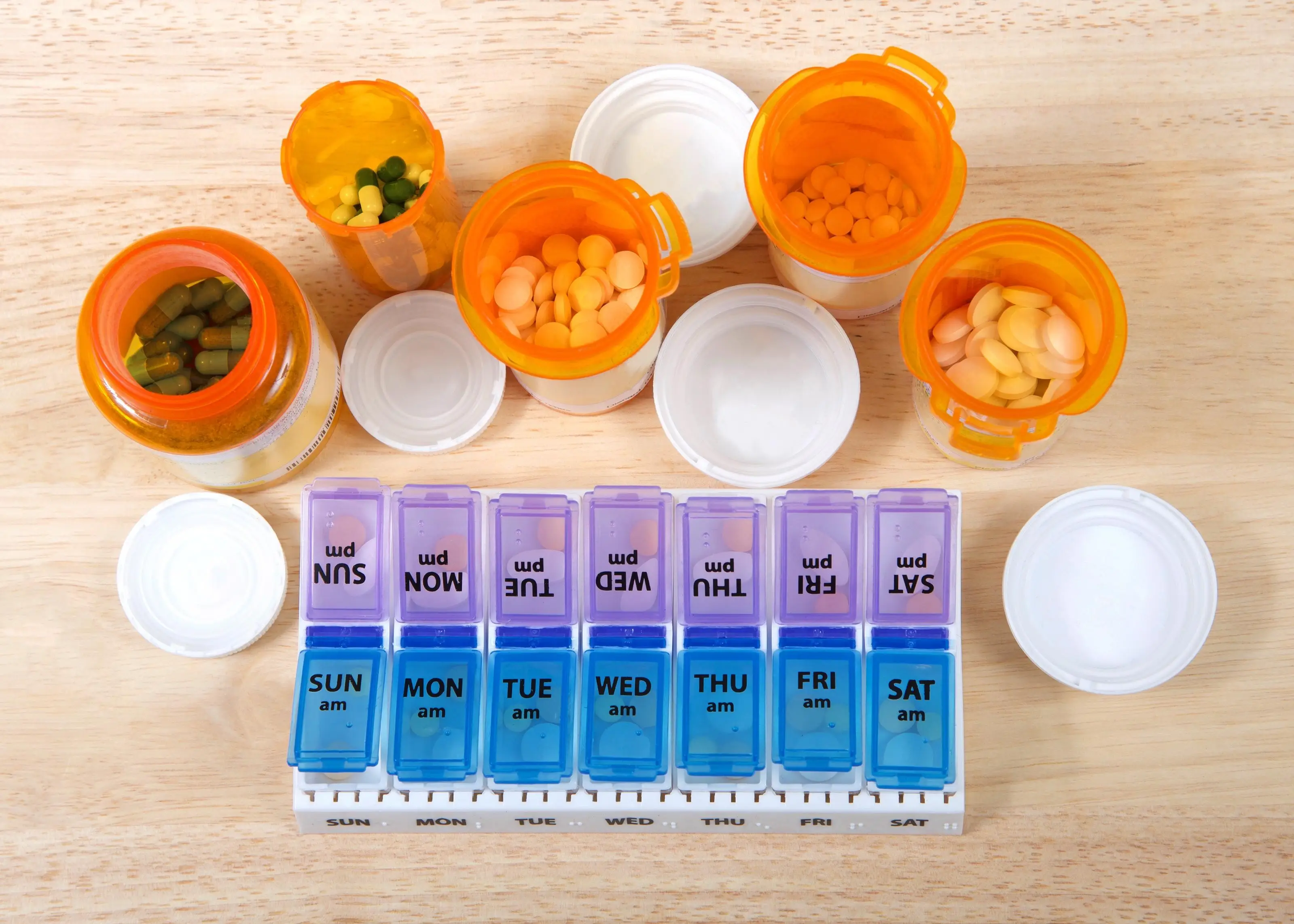
The daily pill box is the most common type: a small plastic container divided into seven compartments, one per day, typically labeled S-M-T-W-T-F-S. Most hold two to four pills per compartment, though versions with larger compartments are available.
Weekly organizers work well for people who take a consistent set of medications once daily and want a simple visual check on whether they've taken today's dose.
Their main limitation: if you take morning, afternoon, and evening doses, a single-row weekly box doesn't have enough compartments. Multi-row weekly organizers with AM/PM or AM/Noon/PM/Bedtime sections address this, but they can be time-consuming to fill and difficult to read, particularly for older adults managing vision changes.

Monthly pill organizers
Monthly organizers hold a 28–31 day supply and are popular among people who fill their own prescriptions and want to reduce the weekly task of sorting. They're bulky, designed for home use, not travel, and take longer to fill, but they work well for anyone with a stable, consistent regimen who has the dexterity and vision to manage a large grid of small compartments.
One limitation worth knowing: even "large compartment" monthly organizers often can't accommodate larger pills without modification. And the sheer visual complexity of 31 rows can be disorienting for anyone experiencing cognitive changes - which is precisely the population most likely to need a monthly system.
Pill canisters and pill wallets
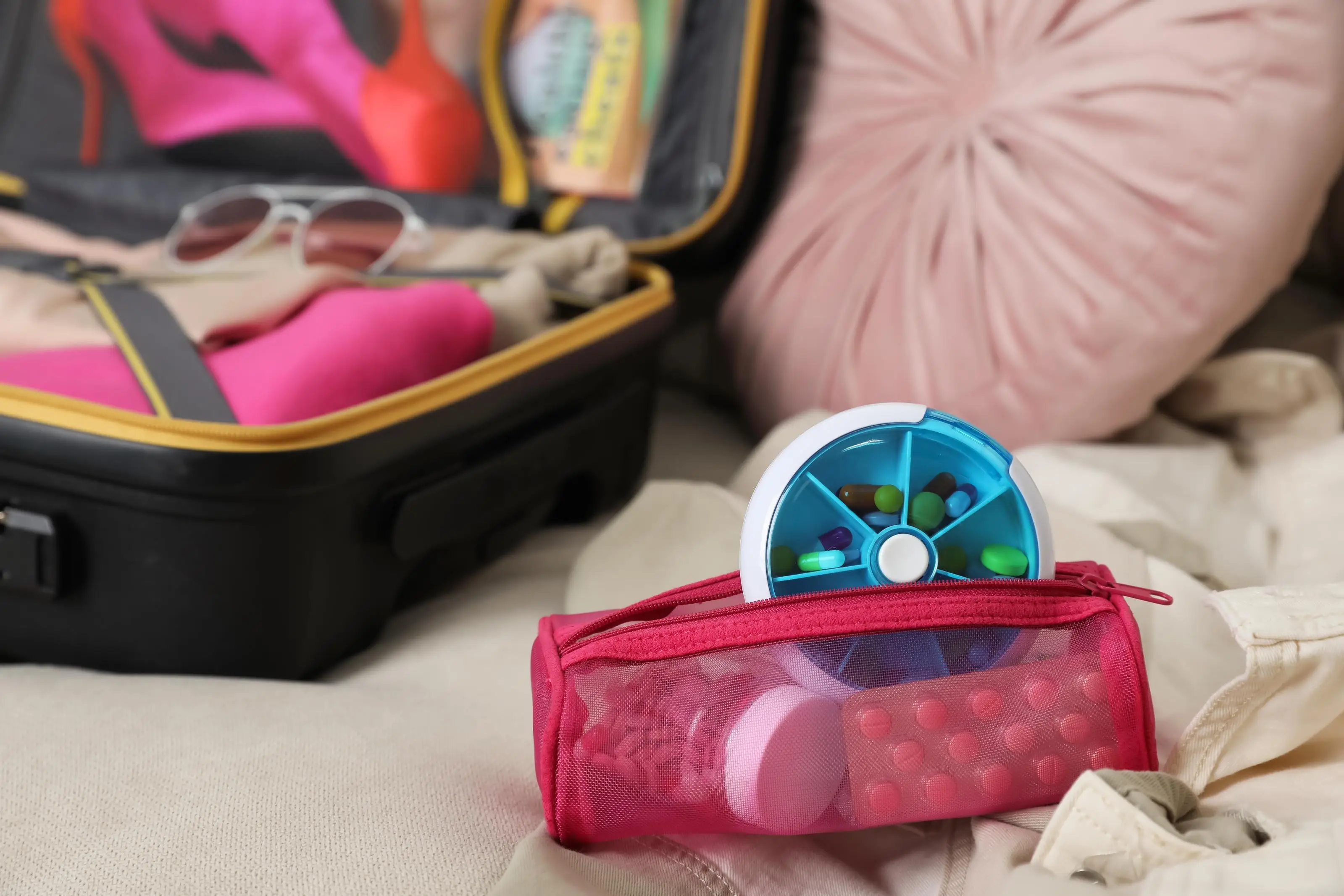
For travel and on-the-go doses, two smaller form factors are worth considering. Pill canisters are compact, often cylindrical containers — some small enough to clip to a keychain — that hold a single day's medications in one compartment. They're discreet and portable, but they offer no organization by time of day; the responsibility for knowing what to take from the combined supply remains entirely yours. Pill wallets are soft-sided fabric pouches, typically with several small zippered pockets, that give travelers a lightweight way to carry a few days' supply. Neither type is well-suited to complex regimens.
Pill organizers with alarms
Pill organizers with built-in alarms add a reminder layer on top of the basic compartment system. The alarm sounds at a scheduled time; you open the corresponding compartment and take your dose. The concept is sound, but the Souza and Santana study documented consistent problems in practice: alarms triggering at the wrong time, electronic displays too small to read without magnification, and buttons difficult to press — particularly for older adults with arthritis or reduced hand strength.1 Whether an alarm organizer helps depends heavily on the specific model. The concept is good; the execution varies widely.
Locking pill organizers
Locking pill organizers add a security layer, preventing unauthorized access to prescription medications - particularly important if you have children in the home or if you're managing controlled substances that carry a risk of misuse. There are several types, from simple keyed locks to more sophisticated combination mechanisms. For a detailed breakdown of what to look for, see our dedicated guide to locking pill boxes.
Are pill organizers actually safe? What the research says
Pill organizers are safe, when used correctly. The longer and more important answer is that "correctly" is harder to achieve than most people assume, and the academic research is clear-eyed about how often errors actually occur.
The correct-use problem
A peer-reviewed study found that only 53% to 68% of older adults using pill organizers did so without meaningful errors.1 Put another way: somewhere between 32% and 47% of people using what most consider a simple and reliable tool were making mistakes. That's a staggering number for something described on packaging as a medication management solution.
What kind of errors?
The most commonly documented mistake is taking medication from the wrong compartment, which can disrupt the entire week's schedule — not just one skipped dose, but a cascading error that's difficult to recover from once the week's organization is off. 1
The same study identified a second, more easily overlooked problem: the ink labeling on pill organizer compartments wore off after only two weeks of regular use. 1 When the day labels disappear, the primary organizational feature of the system disappears with them, and users may not notice until errors have already occurred. A review of pill organizer risks and limitations published in 2013, reached similar conclusions about the real-world gap between how these tools are perceived and how they actually perform.2
It's worth noting that despite how widely pill organizers are used, there is currently no official clinical recommendation for or against their use. A 2020 review published in Prescriber, found that for many people they may not be the most effective option for maintaining adherence.3
When pill organizers are not enough
The research points to a consistent pattern. Pill organizers work best for people with stable, simple regimens, reliable short-term memory, adequate dexterity, and good enough vision to read small labels. When any of those factors is compromised - through age, illness, cognitive change, or the sheer complexity of a multi-drug regimen -the error rate climbs.
A few signals that a pill organizer may be adding risk rather than reducing it:
- You've found yourself uncertain whether you've already taken today's dose.
- You've opened the wrong day's compartment more than once.
- You're managing five or more medications with different timing requirements.
- Someone else is filling the organizer for you and errors have crept in.
If any of those describe your situation, the problem is most likely that the organizer has reached the limit of what it can do for your specific circumstances.
How to choose the right pill organizer for your needs
Choosing the right pill organizer starts with an honest review of your situation - not just your medication count, but your physical abilities, your schedule, and the particular ways your day is structured.
Start by assessing your regimen
Before buying anything, gather every medication you're currently taking and lay one of each out on a table: prescription, over-the-counter, and supplements.
Write a simple schedule: which medications you take at which times of day, whether any have food or timing requirements, and whether any need to be kept separate from the others. This takes about fifteen minutes and tends to reveal things people hadn't consciously noticed.
Some people discover they're managing more medications than they'd registered. Others find their regimen is actually simple enough that a basic weekly box handles it without a problem. Either way, you're making a decision based on your actual situation rather than a general recommendation.
From that inventory, three questions matter most:
- How many separate doses do I take per day?
- Are any of my pills unusually large or difficult to handle?
- Do I need something portable for travel or for midday doses away from home?
The Agency for Healthcare Research and Quality (AHRQ) recommends maintaining an up-to-date medicine list that includes every medication, dose, and timing - a useful starting document for this kind of regimen assessment.4 For guidance on how to store the medications you're organizing, see our guide on dos and don'ts for storing medications, which covers temperature, humidity, and common storage mistakes.
Older adults and accessibility - what changes with age
Age introduces physical changes that most pill organizer reviews simply don't account for. Three matter most: dexterity, vision, and the sheer volume of certain medications.
Reading the fine print on a standard weekly organizer requires vision that many older adults no longer have. Opening snap-close compartments that require simultaneous squeezing and pressing becomes painful or impossible for someone who has arthritis. More than half of adults 65 and older (54%) take four or more prescription drugs7, and 40% of older adults live with some degree of memory impairment.8 For this population, the organizational demands of a manual pill system are compounding in ways a simple weekly box was not designed to handle.
For this group, accessibility isn't a bonus feature. It's the most important specification on the list.
When choosing an organizer for an older adult, look for: compartment buttons that open with a single light push rather than a squeeze-and-press mechanism; large, high-contrast labels; compartments sized for the actual pills being taken, not just average-sized tablets; and a form factor that doesn't require sorting an entire month's supply at once.
Travelers vs. homebodies — portability considerations
If you travel regularly or need to take medication during the workday, portability matters as much as organization capacity. A large monthly organizer that lives on your kitchen counter won't help if it doesn't fit in a carry-on or a work bag.
The most practical approach for people who travel is to maintain two systems: a compact weekly or daily organizer for travel, and your main organizer at home. Color-coding is a simple and effective technique here: using different colored organizers for AM and PM doses, for instance, reduces sorting errors when you're moving between systems or filling in a hurry.
Security needs — opioids, high-risk medications, and children at home
If you're taking opioids, muscle relaxants, sleep aids, or any controlled substance, a standard open-access pill organizer creates a real safety risk. A pill organizer left on a countertop is not secure storage. Children in the home can reach it; visitors can access it; the medications are visible and identifiable.
For households with young children or for anyone whose regimen includes high-risk medications, a locking storage solution is worth the extra step. Our locking pill organizer guide covers the specific options in detail, including what to look for if childproofing is your primary concern versus medication diversion.
When a pill organizer isn't enough — how to know it's time to upgrade
A pill organizer is a passive tool. It holds your medications and marks which day you're on. It tracks nothing. It alerts no one. It has no way of knowing whether the compartment you opened resulted in a dose taken or a dose moved and forgotten. At a certain level of complexity — or when the stakes are high enough — that passivity becomes the core limitation.
Signs a manual organizer is failing you
The signals are usually gradual rather than sudden. You begin to double-dose occasionally. You can't reliably remember whether you took the afternoon pills. Refilling the weekly organizer has become a task you dread enough to delay. Family members are calling to ask whether you've taken your medications.
None of these are signs of carelessness. They're signs that the management problem has grown past what a passive tool can reliably solve — and that the cost of errors is climbing.
Low-tech automatic dispensers — who they're for
Between a pill organizer and a fully connected smart device, there's a middle category: the countertop automatic dispenser. These devices pre-load your medications and dispense them on a set schedule with an audible or visual alert — so you're not sorting pills manually each day, but you're also not paying for monitoring or an app.
The Mobi Smart Pill Dispenser is one option at this level, available through major retailers for $149–$159 as a one-time purchase. It holds 28 compartments and has optional Wi-Fi connectivity, but it does not include caregiver notifications or remote monitoring.5 If family visibility isn't a requirement and you mainly want the machine to handle the dispensing this is a practical starting point.
The tradeoffs with low-tech dispensers are consistent regardless of model: most have limits on how many times per day they'll dispense, they require monthly refilling and hand-sorting, and only the pricier models include a companion app or text reminders. If your schedule is complex or someone else needs to know whether you've taken your dose, you'll likely outgrow this category quickly.
Smart pill dispensers - what they add
Connected smart dispensers go further: they don't just alert you when it's time to take a dose - they track whether you took it, notify a designated family member or caregiver if you didn't, and log your adherence over time so you have a real record to share with your doctor.
Two options at this level are MedaCube and MedMinder. MedaCube is a robust dedicated dispensing unit that stores and dispenses medications on a programmed schedule. It's a one-time hardware purchase currently priced at $1,999.5 MedMinder works on a subscription model at $125 per month, which covers both the device and the monitoring, there's no large upfront cost, but the ongoing expense adds up.5
Both do the core job: they dispense on schedule and send alerts when doses are missed. The main difference is the cost structure: a large one-time investment with MedaCube, or a monthly fee with MedMinder.
Hero Smart Pill Dispenser
Hero is the smart service taking the hassle out of medication management. It's the step you take when a pill organizer has done all it can do and the gaps are still there.
A Hero subscription includes three components working together. The award-winning Hero smart dispenser that automatically sorts and dispenses up to a 90-day supply of up to 10 medications on schedule, you load it once and it handles the dispensing from there.
The Hero app tracks what was taken and when, and sends missed-dose notifications to you and anyone you add as a medication partner.
24/7 support is available by chat, email, or phone.
Hero starts at $29.99 per month on prepaid plans, or $44.99 per month on a month-to-month basis. There is no initiation fee and no hardware purchase required. You are starting a subscription that includes the Hero’s smart pill dispenser (on loan), Hero’s connected app, the support, and a limited lifetime warranty on the dispenser covering malfunctions from regular use, for as long as your membership is active.
A 30-day risk-free trial lets you test whether it fits your life before you decide.
Complex med schedule?
We solved it.
Hero’s smart dispenser reminds you to take your meds and dispenses the right dose, at the right time.

Hero is for people who have already tried a pill organizer, know it isn't working, and are ready for something that removes the daily uncertainty rather than just organizing it. If a weekly box is working for you, use it. But if you're past that point, it's worth learning what else is available.
Key takeaways
- Only 53% to 68% of older adults use pill organizers correctly1, meaning up to one in three makes meaningful errors - the most common being taking medication from the wrong compartment and disrupting the week's entire schedule. A pill organizer is a useful tool, but it is not a passive or foolproof one.
- The right type of organizer depends on your specific regimen, your dexterity, your vision, and whether you need something portable. Choosing based on your actual inventory of medications and timing requirements is more reliable than buying what looks convenient.
- Older adults should prioritize accessibility features over capacity: compartments that open easily, large high-contrast labels, and pill sizes that fit the medications being taken reduce errors more than adding more cells.
- If you take five or more medications, regularly feel uncertain whether you've taken today's dose, or are managing someone else's regimen from a distance, a passive organizer is likely at the limit of what it can reliably do.
- Automatic dispensers range from one-time hardware purchases to subscription services that include an app, caregiver notifications, and support. Understanding what's included — and what isn't - matters as much as the price.
- A pill organizer is a starting point, not a permanent solution. When the uncertainty and the stakes grow past what a box can manage, a connected system built around your actual regimen is worth considering.
Conclusion
There's a drawer in most homes, the one with the pill bottles, the instruction inserts nobody reads twice, the rubber-banded organizer from last year. Getting that drawer under control feels like a small thing from the outside. For the person managing it, it can be one of the more quietly exhausting parts of the week.
The right tool makes that burden manageable. For most people, a well-chosen weekly or monthly organizer genuinely does the job. It creates a visual system, reduces the "did I take this already?" uncertainty, and costs almost nothing. That's not nothing.
But some situations are past what a box can handle, not because the person using it has failed at a simple task, but because the task itself has grown beyond what a passive tool was designed to manage. When the medication count is high, when the timing requirements are complex, when someone else's safety depends on the accuracy of the system, that's when the honest question isn't "which pill organizer is best" but "is a pill organizer still the right category of solution?"
Whatever you land on, the goal is the same: your medications should be one less thing you're carrying around in the back of your mind. Not managed - actually handled.
References
1. Souza, F.R.D., and Santana, C.S. "A descriptive study about the use of pillboxes by older adults." Health. 2013. https://www.scirp.org/html/14-8202599_41217.htm
2. Borja-Oliveira, C.R. "Pill organizers and pill cutters: risks and limitations." Revista de Saúde Pública. 2013. https://www.scielo.br/j/rsp/a/wWq6LsHNFnRSD4Snj6WgqSC/?lang=en
3. Dowden, A. "Do pill organisers improve medication adherence?" Prescriber. 2020. https://wchh.onlinelibrary.wiley.com/doi/10.1002/psb.1865
4. Agency for Healthcare Research and Quality. "Keep a Medicine List." AHRQ. https://www.ahrq.gov/health-literacy/improve/pharmacy/medicine-list.html
5. The Senior List. "Best Automatic Pill Dispensers." https://www.theseniorlist.com/medication/dispensers/
6. Agency for Healthcare Research and Quality, Patient Safety Network. "Medication Errors and Adverse Drug Events." AHRQ PSNet. https://psnet.ahrq.gov/primer/medication-errors-and-adverse-drug-events
7. Kaiser Family Foundation. "Data Note: Prescription Drugs and Older Adults." KFF. https://www.kff.org/health-reform/issue-brief/data-note-prescription-drugs-and-older-adults/
8. Small, G.W. "What we need to know about age related memory loss." BMJ. 2002. https://pmc.ncbi.nlm.nih.gov/articles/PMC1123445/
The contents of the above article are for informational and educational purposes only. The article is not intended to be a substitute for professional medical advice, diagnosis, or treatment. Always seek the advice of your physician or other qualified clinician with any questions you may have regarding a medical condition or its treatment and do not disregard professional medical advice or delay seeking it because of information published by us. Hero is indicated for medication dispensing for general use and not for patients with any specific disease or condition. Any reference to specific conditions are for informational purposes only and are not indications for use of the device.