How to Keep Your Medications Safe and Secure at Home

Each year, about 50,000 children under five are treated in emergency rooms after accessing unsupervised medications — and children aren't the only ones at risk. This guide explains who in your household needs protection from unsecured medications, what locking pill box and storage options actually work, and how to safely dispose of what you no longer need.
Why medication security matters at home
Most people store their medications the same way they store everything else — in a cabinet, on a counter, wherever is convenient. It works until it doesn't.
According to the CDC's PROTECT Initiative, unintentional medication overdose is the leading cause of emergency department visits in children under five — roughly 50,000 ER visits per year from unsupervised medication ingestion.1 That's not children getting into obviously dangerous products. That's children finding a pill bottle that looked interesting, usually while an adult was in the next room.
Human medications are also the leading toxin category reported to the ASPCA Animal Poison Control Center. In 2024, over-the-counter human medications ranked first among pet toxin exposures for the eleventh consecutive year, making up 16.5% of all calls to the center. Prescription medications ranked third.3 Dogs encounter dropped ibuprofen, heart medications left on counters, and pill bottles that happen to smell like something worth investigating.
Then there's diversion. According to CDC data from the 2023 National Survey on Drug Use and Health, more than a quarter of people who misused prescription opioids obtained them from a friend or relative. From 1999 to 2023, nearly 308,000 Americans died from overdoses involving prescription opioids.5 A meaningful portion of those deaths traced back to medications that came from someone's home.
None of this is meant to alarm you. It's meant to make the case for something simple: the medications in your home are more powerful and more accessible than most people treat them.
Who in your household is most at risk?
The right storage solution depends on who you're protecting. These four groups face the greatest danger from unsecured medications.
Young children under five
Children in this age group are fast, curious, and have no concept of what a pill is. The CDC PROTECT Initiative notes that finding and eating medicines without adult supervision is the leading cause of medication-related ER visits in children under five.1 A particularly troubling pattern shows up in the data: more than half of pediatric pill poisonings involved medication an adult had already removed from child-resistant packaging — transferred to a pill organizer, left on a nightstand, or set out for the day.2 Child-resistant packaging only works if the medication stays in it.
Cardiac medications and diabetes drugs are especially dangerous in small doses. CDC data shows that in more than half of cases involving those drug types, the medications belonged to a grandparent rather than a parent — a detail worth keeping in mind if medications travel with older family members during visits.2
Pets
Dogs are the highest-risk pets, but cats are not immune. The ASPCA Animal Poison Control Center handled more than 451,000 animal cases in 2024,4 and OTC human medications topped its toxin list for the eleventh straight year.3 Ibuprofen, ADHD medications, and heart medications are among the most common culprits.3 The risk is usually accidental: a dropped pill, a bottle left within reach, a medication transferred to an unmarked container a dog finds interesting. Secure storage removes that variable entirely.
People recovering from substance use disorder
This one is harder to talk about, but worth naming directly. If someone in your household is recovering from addiction — whether that's a family member, a roommate, or yourself — having controlled substances within reach is a documented risk factor. The DEA's "Secure Your Meds" campaign was built around a finding that repeats across federal surveys: most diverted prescription drugs don't come from dealers. They come from people's homes.6
Locking your medications is not a statement of distrust. It's the same logic as not leaving alcohol on the counter for someone trying not to drink. It removes temptation and reduces risk without requiring a difficult conversation.
Older adults with dementia or memory loss
When memory and cognition decline, medication management becomes genuinely hazardous — not because of others accessing medications, but because the person taking them may lose track of what they've already taken. A systematic review published in BMC Geriatrics found that as dementia progresses, people lose the capacity to plan and organize medication tasks, making them vulnerable to taking duplicate doses or missing doses entirely.7 One family carer in the research described it plainly: "One day she might forget, another day she might take two lots."7
Locked or controlled storage can help in these situations, but it's worth being honest about its limits. If someone has significant memory loss and cannot reliably track their own dosing, locked storage addresses only part of the problem. Active caregiver involvement in the dosing process is still necessary.
Types of locking medication storage
There is no single right answer — the best option depends on your household and how much access control you actually need.
Locking pill organizers are the most accessible starting point. These look like standard weekly or monthly organizers but include combination locks or key locks on the lid. They're portable, inexpensive, and practical for households that want a straightforward barrier against casual access — a young child wandering in, a houseguest with unsupervised access to a bathroom. They're less effective as a serious deterrent for a teenager or a motivated adult. For a broader comparison of pill storage options, see our comparison guide.
Lockboxes and medication safes offer stronger protection. These are small, solid containers designed to hold pill bottles or loose medications and require a combination or key to open. Many can be mounted or bolted in place, which prevents the box itself from being removed. For households with a higher-risk profile, this is the more reliable option.
Wall-mounted and cabinet-mounted systems are worth considering if you want something permanent. These mount directly inside a cabinet or to a wall and provide lockable storage that stays put. They're common in households where a caregiver manages medications for an older parent, and they're a practical solution for anyone who wants controlled access without a freestanding lockbox taking up shelf space.
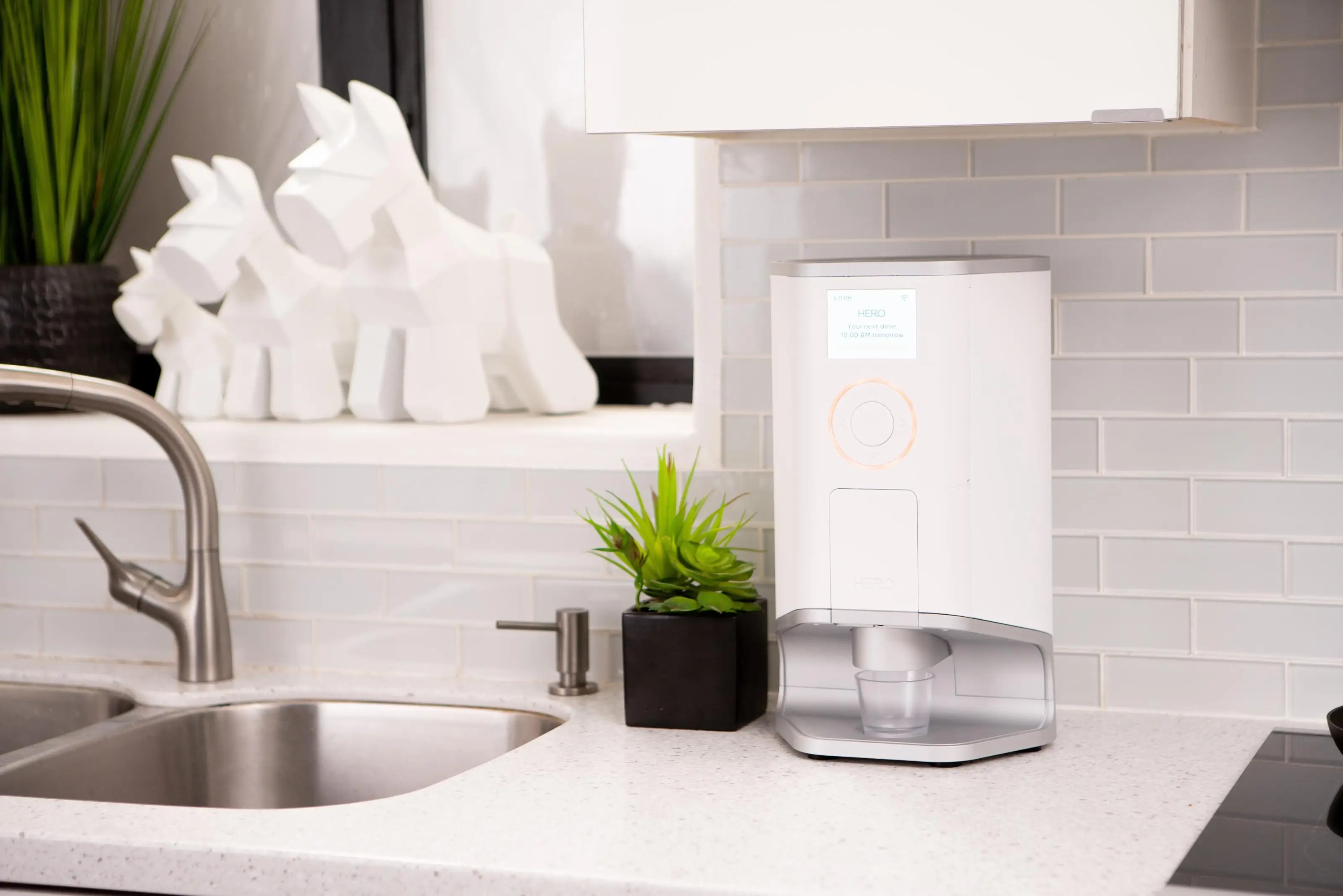
Smart dispensers with passcodes add an electronic layer of control.
One important note: Hero is not designed for people with severe memory loss, Alzheimer's, or dementia who cannot self-monitor their own dosing. For those situations, a caregiver needs to be directly involved in the medication process — the dispenser supports adherence but does not replace that oversight.
If you're curious whether Hero could work for your household, the service comes with a 30-day risk-free trial.
How to store high-risk medications
Not all medications carry the same risk, and some warrant extra care beyond a standard locked organizer.
Controlled substances and opioids
The DEA recommends that all controlled substances be stored in a locked location.6 This includes prescription opioids (oxycodone, hydrocodone, codeine), benzodiazepines, and stimulants like Adderall. These are the medications most likely to be sought out deliberately — by a teenager, a houseguest, or someone in the household dealing with substance use. A dedicated lockbox or a smart dispenser with a PIN code is the appropriate storage method. A cabinet with a simple latch is not.
When you no longer need a controlled substance, the right move is prompt disposal. The DEA operates more than 17,000 year-round collection sites at pharmacies and police stations;10 you can find your nearest location at this link.
Medications toxic to children in small doses
Several common medications are dangerous to young children at doses that would barely affect an adult. These include cardiac medications (beta-blockers and calcium channel blockers), diabetes medications (sulfonylureas), sleep aids, iron supplements, and ADHD stimulants — all flagged by the CDC as high-risk in pediatric poisoning cases.2 A single tablet of certain cardiac or diabetes drugs can cause serious harm to a toddler.2
These should stay in their original child-resistant packaging and be stored locked; not just placed up high. Children climb.
What to do with unused or expired medications
Secure storage matters while medications are in use. What you do with them after is equally important.
The FDA recommends drug take-back programs as the first choice for disposing of most unused or expired medications.8 You can drop them at a pharmacy or police station drop box, or use a prepaid mail-back envelope and leave it at any USPS location. To find a year-round collection site near you, use the DEA's locator at apps.deadiversion.usdoj.gov/pubdispsearch.
For medications on the FDA's flush list — primarily high-risk opioids and a small number of other drugs that can be fatal in a single dose — flushing is appropriate when a take-back option isn't available.9 The FDA maintains a current flush list at this link. Don't flush anything that isn't on this list.
For everything else without a nearby take-back option: mix the medication with something unappealing — dirt, used coffee grounds, cat litter — seal it in a plastic bag, and put it in the trash. Scratch out your personal information on the prescription label before discarding the packaging.
Key Takeaways
- Unintentional medication ingestion is the leading cause of ER visits in children under five — and more than half of those cases involve medication already removed from child-resistant packaging.
- OTC human medications have ranked as the top pet toxin for eleven straight years, according to the ASPCA Animal Poison Control Center (2024).
- More than a quarter of people who misused prescription opioids in 2023 obtained them from a friend or relative — secure home storage is one of the most direct ways to reduce household diversion.
- The right locking solution depends on who you're protecting: a locking pill organizer suits some households; a mounted lockbox or a smart dispenser with a PIN code suits others.
- The DEA recommends storing all controlled substances in a locked location and using authorized take-back programs for disposal.
- For someone with significant memory loss or dementia, locked storage alone is not sufficient — active caregiver involvement in the dosing process is necessary.
Keeping you and others safe
Most medication safety conversations focus on what happens at the pharmacy or in a clinical setting. The harder truth is that most preventable medication harms happen at home, in ordinary moments: a toddler who wandered off for 90 seconds, a dog who found something interesting on the floor, a family member who needed help staying on track with their recovery.
You can't control everything. But you can make access harder for the people and pets in your home who are most at risk. A locking organizer, a bolted lockbox, a smart dispenser with a passcode — none of these are complicated. They're just decisions that most of us keep putting off because nothing bad has happened yet.
The right moment to change how you store medications is before you need to.
References
1. CDC PROTECT Initiative. "About the PROTECT Initiative." Centers for Disease Control and Prevention. cdc.gov/medication-safety/protect/index.html.
2. CDC. "Adults Unintentionally Make It Easy for Young Children to Eat Dangerous Pills." CDC Newsroom Archive, February 12, 2020. archive.cdc.gov/www_cdc_gov/media/releases/2020/p0212-dangerous-pills.html.
3. ASPCA Pro. "Top 10 Toxins of 2024." ASPCA Professional. aspcapro.org/resource/top-10-toxins-2024.
4. ASPCA. "ASPCA Sees Increase in Number of Calls to Poison Control Center in 2024." ASPCA press release, 2025. aspca.org/about-us/press-releases/aspca-sees-increase-number-calls-poison-control-center-2024-including-rise.
5. CDC. "About Prescription Opioids." Overdose Prevention. Centers for Disease Control and Prevention. cdc.gov/overdose-prevention/about/prescription-opioids.html. Data from 2023 NSDUH.
6. DEA. "DEA Launches Secure Your Meds Campaign, Calls on Americans to Keep Medications Safe." DEA Press Release, April 21, 2020. dea.gov/press-releases/2020/04/21/dea-launches-secure-your-meds-campaign-calls-americans-keep-medications-3.
7. Hinton L, et al. "Medicines management issues in dementia and coping strategies used by people living with dementia and family carers: A systematic review." BMC Geriatrics, 2018. pmc.ncbi.nlm.nih.gov/articles/PMC6282522/.
8. FDA. "Disposal of Unused Medicines: What You Should Know." U.S. Food and Drug Administration. fda.gov/drugs/safe-disposal-medicines/disposal-unused-medicines-what-you-should-know.
9. FDA. "Drug Disposal: FDA's Flush List for Certain Medicines." U.S. Food and Drug Administration. https://www.fda.gov/drugs/disposal-unused-medicines-what-you-should-know/drug-disposal-fdas-flush-list-certain-medicines.
10. DEA Diversion Control Division. "National Prescription Drug Take Back Program." Drug Enforcement Administration. https://www.dea.gov/everyday-takeback-day.
Frequently Asked Questions
No locking container is completely childproof, but locked storage is significantly more protective than unlocked storage. The CDC's PROTECT Initiative identifies unintentional medication overdoses as the leading cause of emergency department visits in young children, and notes that the greater risk comes from medications that have already been removed from their original child-resistant packaging — transferred to organizers or left accessible. Keeping medications in their original packaging inside a locked container reduces risk substantially. That said, no lock replaces direct supervision of young children around medications.
Possibly yes. If you have no children or pets and no visitors with access to your medications, your immediate household risk is lower. But the DEA's Secure Your Meds campaign recommends locked storage for controlled substances regardless of household composition, because medications can be accessed by repair workers, houseguests, or others with occasional access to your home. For high-risk medications — opioids, benzodiazepines, stimulants — locked storage is a reasonable baseline regardless of who you live with.
Many caregivers use locked dispensers or lockboxes to help manage medications for a parent who has difficulty self-administering safely — particularly when memory loss makes accidental double dosing a real concern. The National Institute on Aging recognizes medication management as one of the most important roles a family caregiver takes on. The most important thing to keep in mind is that the setup should support the person's care and their sense of dignity. If you're navigating this for the first time, our article - Caregiving for a Parent with Dementia covers medication management and daily routines in a lot more depth.
Complex med schedule?
We solved it.
Hero’s smart dispenser reminds you to take your meds and dispenses the right dose, at the right time.

The contents of the above article are for informational and educational purposes only. The article is not intended to be a substitute for professional medical advice, diagnosis, or treatment. Always seek the advice of your physician or other qualified clinician with any questions you may have regarding a medical condition or its treatment and do not disregard professional medical advice or delay seeking it because of information published by us. Hero is indicated for medication dispensing for general use and not for patients with any specific disease or condition. Any reference to specific conditions are for informational purposes only and are not indications for use of the device.